Nepal A Pictorial Journey
Pages:- 128 – Edition: 2024 – Binding: Paper cover and Hard cover
- Artikelnummer
- M2-NP
Nepal A Pictorial Journey
Short Introduction of the Book:
That is what Nepal remained up until a few decades ago, hardly noticed or mentioned by any except being
occasionally alluded to in association with Mt. Everest and the Himalayas. As the country shed the shackles of self-imposed isolationism in 1950s, the iron gates finally opened, but just ajar, allowing only the truly interested, intrigued or initiated explorers, researchers and visitors. Thanks to Kirkpatricks, Hillarys and Hagens and their inspiring works and feats that Nepal soon caught the attention and imagination of the
people around the world.
This tiny Himalayan Shangri-La is, in fact, a land of wonders, a land of superlatives: one of the poorest countries with one of the richest cultures, one of the smallest with the most rugged terrain and the highest mountains, and this list could go on. It’s a country where Man and God, Nature and Supernatural live in harmony, in a close symbiotic relationship. In the ancient times, sadhus and monks thronged to it as their Promised Land for transcendental meditation and nirvana. In the modern times, during 1960s and 70s,hippies of the world made it their haven and called it a heaven. And, all through the ages, diverse people from the north and the south with visibly distinctive forms and features, languages and cultures sought here shelter converting this tiny nation into a veritable mosaic of variegated ethnicity of Tibetan, Tibeto-Burman, Aryan and Mongoloid origins.
However, it is primarily in how nature has manifested herself and edified the ethos of this nation that its pristine beauty and uniqueness lie. Looking towards the north, one can see from any of the numerous vantage points a kaleidoscopic spectrum of colors and patterns – from the lush green hills teeming with colorful flowers to the barren rocky steep surfaces and plateaus to the sky-piercing snow clad peaks of the Himalayas. The 800 km long stretch of Nepal Himalayas boast eight highest mountain peaks (above 8,000 m) of the world including Mt. Everest. And, nowhere but in Nepal can one walk through a labyrinth of such contrasting divergence in topography, biodiversity, climatic conditions and environmental variations within a distance of 125 miles (200 km), the total width of the country from north to south. This tiny Himalayan Shangri-La, just over 0.1% of the earth’s land surface, has the pride of being the natural habitat of 4.2% butterflies (635 species), 2.2 % of fresh water fish (185 species), 1.1 % amphibians (43 species), 1.5% reptile (100 species), 8.5% of birds (860 species) and 4.2% mammals (181 species) at the global scale and 6500 species of trees, bushes and flowers.
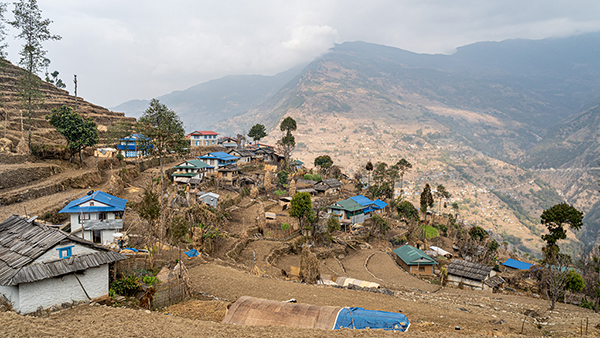
Agriculture, though still very traditional, is the mainstay of national economy and the livelihood of the people. And, the farming patterns and the people’s lifestyle literally follow the rhythm and pattern of the hills and mountains and the vagaries of nature. The fertile plains of the south, the carved out terraces in the mid hills and the seasonal pastures of the high mountains support and yield an amazing variety of crops and animals from tropical/subtropical to alpine species. Likewise, the religious practices and rituals combine the local environment-friendly features and the universal spiritual needs of humankind. The two major religions, Hinduism and Buddhism, coexist independently but in perfect harmony. In most places, their sacred deities placed side by side to worship for the devotees of both religions, they are indistinguishable. No place in the world is possibly so populated with a variety of sacred spots: mountains and passes, creeks and crevasses as the abode or personified image of gods and goddesses; river confluences as the meeting point of cosmic energy and deities; exotic flora and fauna as demigods or objects of spiritual merit; rocks and ammonites as the icons and symbols of the supernatural being for the people of all faiths – Hinduism, Buddhism or animism.
And, as the book clearly portrays, Nepal has something unique to offer to the people of all kinds of needs, interests, temperament and disposition. There abound rapid Himalayan waters, and creeks and cliffs for rafting and bungee jumping for the fun-venturous; untrodden trails in virgin territories for the ardent trekkers; unmatched pilgrimage sites for the religious; unspoilt natural and cultural heritages for the connoisseurs; a living laboratory to assess the effects of global warming and the ills of modern development on nature and human beings for the scientists and researchers; and above all, the towering snow-clad peaks of the Himalayas to the truly adventurous. Nepal indeed deserves a visit in one’s lifetime, but a single visit, we know, will only serve as an appetizer.